If you’re searching for WordPress website design cost New Jersey, you’re probably trying to avoid two bad outcomes: overpaying for a basic site, or underpaying and ending up with a slow, messy build that’s painful to maintain. The truth is WordPress pricing in NJ isn’t “one number”—it’s a range based on scope, content, and complexity.
From the freelancer/studio side (TAMARA & Co.), the fastest way to understand pricing is to separate website cost into two buckets:
- Build cost (one-time): design + development + launch
- Ownership cost (ongoing): hosting, updates, security, small improvements, and content
Once you see those clearly, most quotes start making sense.
The quick NJ pricing reality (what the market looks like)
Web design pricing varies, but two market signals help set expectations:
- Many web design projects reviewed on Clutch come in at less than $10,000, which aligns with what most small businesses budget for a modern brochure-style website.
- Clutch also lists common agency web design hourly rates around $100–$149/hour (and that’s before factoring in add-ons like copywriting, SEO, or advanced integrations).
At the same time, WordPress and other web-builder work is often priced lower hourly when the job leans on reusable frameworks and page builders (because production is faster), with Clutch listing WordPress web-builder rate ranges like $25–$49/hour in its pricing breakdown.
What that means in plain English: NJ clients may see wide pricing even for “the same website,” because two teams can build the same-looking site in very different ways.
What actually drives the cost (the 8 real variables)
When someone asks “website design pricing NJ,” these are usually the levers that move the quote up or down.
- Sitemap & page count: A focused 5–7 page site is a different job than 20–40 pages with multiple service lines and locations.
- Custom design vs. proven layout system: Fully custom UI costs more than using a refined base design system and tailoring it to your brand.
- Content readiness: If your copy and images are not ready, the project becomes part strategy, part production.
- Functionality: Booking, ecommerce, memberships, gated content, calculators, portals, or multilingual sites add build time.
- Forms & automations: Advanced forms (conditional logic, file uploads) and CRM integrations tend to add real complexity.
- SEO foundation: Proper on-page structure and technical basics are not “extras” if you care about rankings.
- Performance & Core Web Vitals: Optimizing assets, fonts, caching, and mobile UX adds effort but protects conversions.
- Compliance & risk: Certain industries (medical, legal, finance) often need tighter privacy, accessibility, and content review processes, which can add time.
Pricing tiers (a better way to think about cost)
Instead of “how much does a contractor website cost vs a medical website,” pricing is usually clearer when grouped by build level. Most industries fit into one of these tiers—only the feature checklist changes.
Starter WordPress site (lean and professional)
Best for: new businesses, single-location services, simple lead gen
Typical scope:
- Core pages (Home, About, Services, Contact, Reviews)
- Mobile-friendly design
- Basic on-page SEO structure (titles, headings, internal links)
- Contact form + spam protection
Budget expectation: usually the “lower investment” tier, especially if branding and content are ready.
Growth site (most common for NJ small businesses)
Best for: businesses competing in local SEO, running ads, or expanding service lines
Typical scope:
- More service pages (and sometimes location pages)
- Stronger conversion layout (CTAs, trust signals, proof)
- Tracking setup (GA4 events, basic funnel visibility)
- Faster performance targets, cleaner templates for scaling content
Budget expectation: mid-tier projects often land in the “most projects are under $10k” reality mentioned earlier, depending on scope.
Advanced site (ecommerce, booking, portals, integrations)
Best for: online sales, appointment-based businesses, memberships, multi-step workflows
Typical scope:
- Ecommerce (WooCommerce) or booking stack
- Product/service architecture, automation, email flows
- Integrations (CRM, payment gateways, shipping/tax logic)
- More QA/testing and stronger security posture
Budget expectation: frequently moves into five-figure territory when the site is truly part of operations (not just marketing).
Rough packages (NJ market baseline — update as needed)
These packages are meant as a starting point based on common NJ expectations and the broader market signals (many projects coming in under $10k, with many agencies charging roughly $100–$149/hour).
Exact pricing depends on content readiness, number of unique templates, and feature complexity, so treat the ranges below as planning numbers—not final quotes.
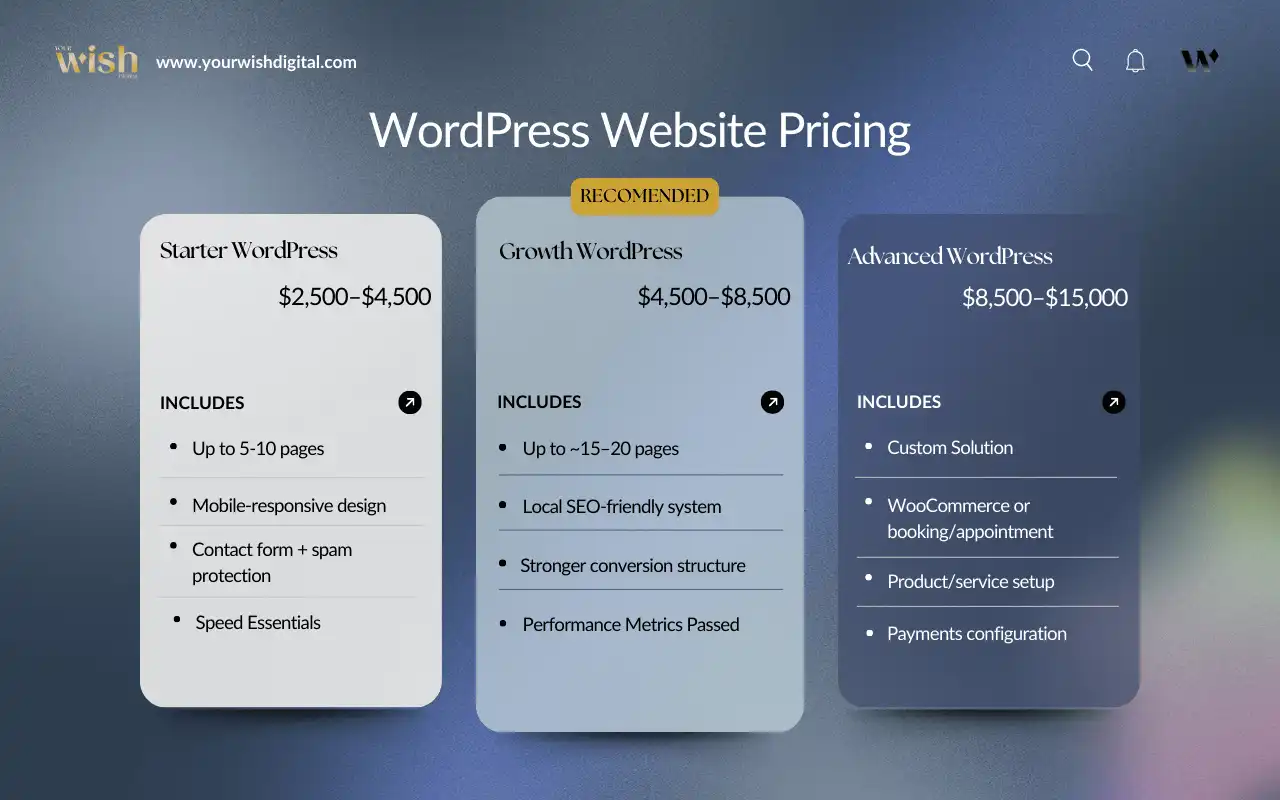
Package 1: Starter WordPress (Launch-Ready)
Typical budget (NJ): $2,500–$4,500
Timeline: ~1–2 weeks (when content is ready)
Includes
- Up to 5 pages (template-based layout system, branded styling)
- Mobile-responsive design
- Contact form + spam protection
- Basic on-page SEO setup (titles/meta, headings, internal links)
- Speed essentials (image compression, caching baseline)
- Launch + basic training (how to edit pages)
Best for
- Local service businesses, solo professionals, new businesses that need a clean site fast
Common add-ons
- Copywriting, photography/stock images, extra pages, blog setup
Package 2: Growth WordPress (Local SEO + Conversions)
Typical budget (NJ): $4,500–$8,500
Timeline: ~2–4 weeks
Includes
- Up to ~10–15 pages (or 2–3 core templates used across more pages)
- Stronger conversion structure (CTA sections, trust blocks, reviews, FAQs)
- Local SEO-friendly architecture (service pages, optional location pages)
- GA4 + basic event tracking setup (form submits/click-to-call)
- Performance pass (Core Web Vitals-minded cleanup, asset optimization)
- Editable section templates for scaling content
Best for
- Growing NJ businesses competing in local search or running paid traffic
Common add-ons
- Dedicated landing pages for ads, multi-location SEO plan, CRM integration
Package 3: Pro / Advanced WordPress (Ecommerce, Booking, Integrations)
Typical budget (NJ): $8,500–$15,000+
Timeline: ~4–8 weeks
Includes
- WooCommerce or booking/appointment stack
- Product/service setup (structure, categories, key pages)
- Payments configuration and core checkout settings
- Advanced forms and automations (conditional logic, routing, CRM)
- More QA/testing across devices and browsers
- Stronger security and backup configuration
Best for
- Ecommerce brands, appointment-based businesses, memberships, and workflow-heavy sites
Common add-ons
- Shipping/tax rules, subscriptions, membership portals, custom integrations, ERP/advanced CRM
Optional: Monthly care plan (recommended)
Typical budget (NJ): $75–$249/month (depending on site complexity)
Common inclusions
- WordPress/plugin updates + compatibility checks
- Daily/weekly backups + uptime monitoring
- Security monitoring and malware cleanup support
- Small monthly content edits (time-bucket)
- Performance monitoring and quick fixes
Get full details on our care plan packages and other one time services we are offering currently. Click here
One-line pricing note (use under packages)
Many NJ agencies publicly list hourly ranges around $100–$149/hour, so fixed packages can help business owners avoid open-ended billing while still matching local market realities.
Freelancer vs agency in New Jersey (what you’re paying for)
Both models can be a good fit—it depends on what you need and how you work.
When an agency makes sense
- You want a full team (designer, developer, PM, SEO, copy) under one roof.
- You need a formal process, stakeholder management, and multiple rounds of review.
- You expect higher hourly rates as the tradeoff for structure and capacity (Clutch’s $100–$149/hour range is a common benchmark).
When a freelancer/small studio makes sense
- You want senior execution and fewer handoffs.
- You want speed and direct communication.
- You have clear goals and can approve decisions quickly.
As a studio-style freelancer setup, TAMARA & Co. typically sits in the middle: enough process to run clean projects, but lean enough to keep momentum.
Industry examples (yes—WordPress covers all of these)
If you’re thinking, “But I’m not a typical small business,” it’s still the same pricing framework. Here’s how different industries change features, not the platform.
- Service businesses (NJ local): service pages, review sections, quote/estimate forms, service-area targeting, click-to-call UX.
- Contractors & home services: project galleries, before/after layouts, financing badges, service-area pages, seasonal promos.
- Medical & wellness: provider/service templates, appointment request flows, accessibility-focused layout, careful content review.
- Law firms: practice-area structure, intake forms, credibility blocks, fast mobile experience for high-intent searches.
- Ecommerce brands: WooCommerce setup, product categories, payment configuration, shipping/tax rules, core store SEO.
- Real estate & rentals: property listings, filters, booking/inquiry flow, map embeds, lead routing.
No matter the niche, the question is always: “What does the website need to do?” That answer determines scope.
Ongoing costs (the part most quotes don’t include)
Even after launch, every WordPress site has operating costs. A realistic plan usually includes:
- Hosting + domain: DIY WordPress cost guides commonly include domain and hosting as recurring costs (for example, Elementor’s 2026 cost scenarios show domain + hosting as annual line items).
- Premium plugins: Some sites can stay mostly free, but many businesses eventually pay for SEO, security, forms, backups, or ecommerce extensions (Hostinger notes premium themes/plugins can range widely per license).
- Maintenance & support: Updates, security monitoring, backups, fixing conflicts, and small improvements.
If you want predictable spending, offer (or choose) a monthly care plan that includes updates, backups, security, uptime monitoring, and a small block of time for edits.

How to get an accurate quote (copy/paste checklist)
If you want a real number quickly (and avoid “starting at…” pricing), send this to your web designer:
- Your business type + goal (leads, bookings, ecommerce, credibility, recruiting, etc.)
- Approximate page count (and which pages are unique vs repeated templates)
- 3–5 competitor sites you like (and what you like about them)
- Required features (booking, payments, membership, CRM, multilingual)
- Who provides copy + photos (and when)
- Deadline + who approves feedback
This reduces revisions, tightens scope, and keeps pricing fair on both sides.
FAQ (helps SEO and conversions)
How much does a small business website cost in NJ?
Most small business sites land in a budget range that aligns with “many projects under $10,000,” but the final number depends on pages, content, and features.
Why do NJ website quotes vary so much?
Because teams charge different hourly rates (often $100–$149/hour for agencies) and build with different methods, from custom design/development to faster WordPress frameworks.
Is WordPress still a good choice in 2026?
Yes, especially for businesses that want control over content, SEO flexibility, and the ability to scale features over time (ecommerce, booking, memberships) without rebuilding from scratch.